

Before the day begins
Slow Medicine For a Fast World

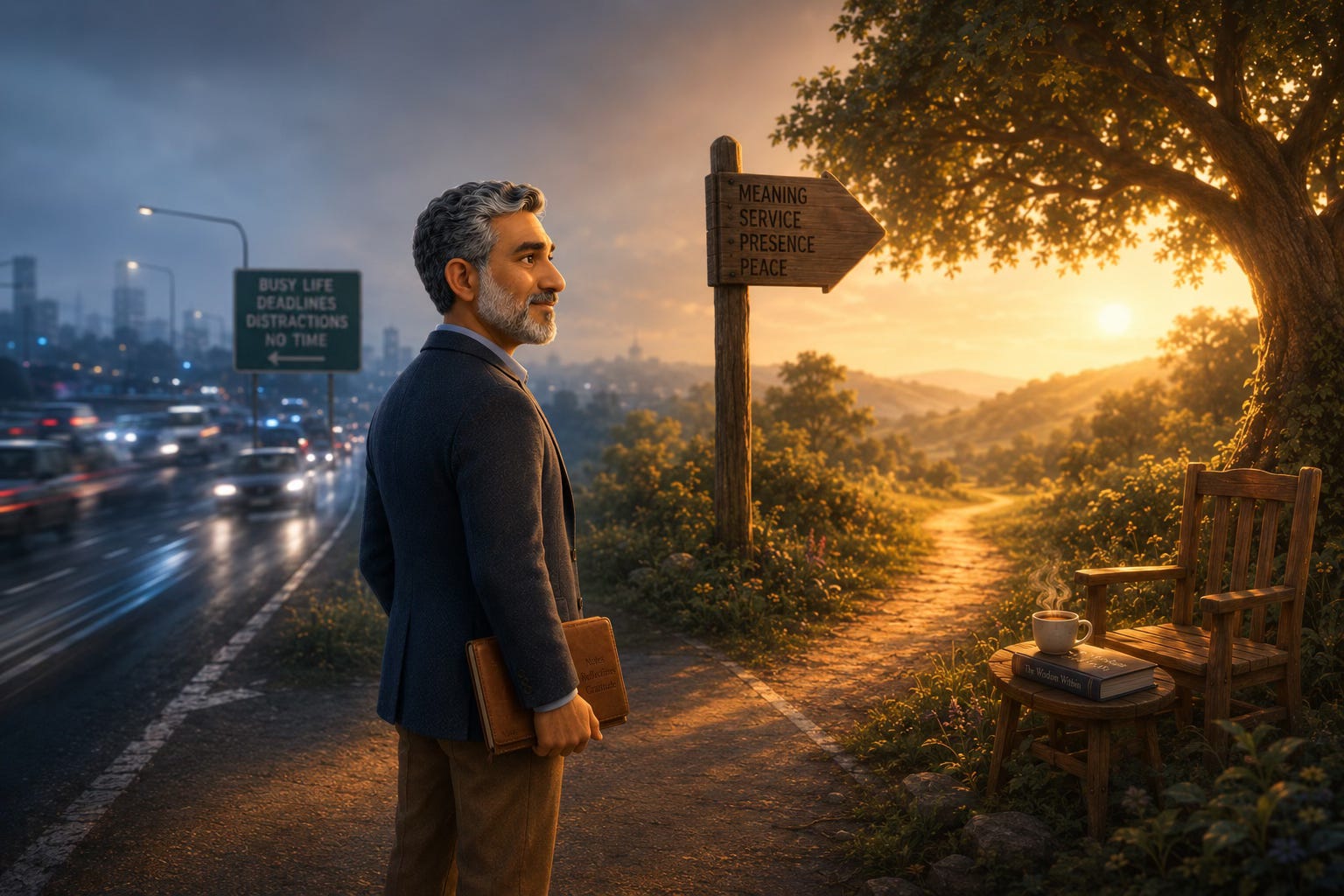
Something happens to time when I land in Pakistan. After the long flights, after the disorientation of borders and customs, within a day or two of being at my parents’ home, something shifts. The hours stop hurrying. A morning that would compress itself into a blur back in Pennsylvania spreads out instead, generous and unrushed. Tea takes its full time. A conversation with my father drifts wherever it wants to go. By the time the call to Maghrib reaches the house, I find myself surprised the day has lasted so long.
I used to think this was just the leisure of vacation. I no longer believe that. Something more interesting is happening, and once you notice it, you cannot unsee it.
In the Pakistan I visit each quarter, time still belongs to people. In the America I work in, time has been parceled out and resold in fifteen-minute increments. We do not have hours anymore. We have slots.
Patients arrive having waited weeks for their slot. The slot expires before the question does. The next slot is already filling. By the end of the week the schedule has consumed the doctor, and the doctor has not seen a single full human being. Everyone is moving fast, and yet nothing seems to actually arrive.
I lived inside that arithmetic for years. Eleven hour days were normal. Locum work added long highways to the ledger. I drove past sunsets I never saw, ate meals I do not remember, and walked into rooms where I was already half gone before I sat down. Burnout, when it came, did not arrive as collapse. It arrived as a slow drying up. The work was still getting done. The doctor inside the work had quietly left.
When I finally listened, the changes I made were unfashionable. I cut my clinical days from nine and eleven hours to six. I gave up the locum driving. I narrowed my work to two clinics within a small radius of my home. On paper this looked like withdrawal. Fewer hours billed, fewer patients seen, fewer miles. The first months felt like loss.
The cut in hours came with a cut in income, and it was not small. My wife and I sat down and decided what mattered. Family mattered more. My health, mental and physical, mattered more. We adjusted what we spent. Some things we used to buy without thinking we no longer buy. Nothing about this felt heroic at the time. It felt like arithmetic, the kind a family does at a kitchen table when it is finally telling itself the truth.
What I did not expect was that the saved hours would not behave like the hours I had been spending. They had a different texture entirely. An afternoon at home with a book extended itself the way an afternoon never extended at the clinic. A walk with my wife became long without being long. The day, freed from being a corridor between appointments, became something more like a room you can move around inside.
This is the part that surprises Western readers and that any of my elders in Pakistan would consider obvious. Time does not behave the same way at all speeds. When you crowd it, you destroy it. When you give it room, it gives itself back to you, and more. The hours expand. You get a longer day from a smaller calendar.
Henri Bergson drew a distinction between two kinds of time. There is clock time, which is uniform, divisible, and cheap. And there is duration, which is lived, qualitative, and unrepeatable. Modern medicine runs almost entirely on the first. Healing, when it actually happens, runs almost entirely on the second. We have built a system that excels at producing the wrong thing.
I see this every week in clinic. A patient who is allowed to take fifteen minutes to settle into the room before saying anything important will say something important. A patient who is rushed will not. The information was always there. The clock was the problem.
In traditional cultures, this is not a discovery. It is a default. The Prophet Muhammad, peace be upon him, would turn his whole body toward the person speaking, not just his face. He would not interrupt. He would let silences sit. The companions who described him kept returning to this quality, the way time around him seemed to slow down. It made people feel seen. It made them tell the truth. Looked at clinically, this is one of the most therapeutic postures a human being can take. It is also nearly extinct in our hospitals.
When I visit Pakistan, I notice that ordinary people still know how to do this. The shopkeeper who closes the till to ask about your father is not failing at retail. He is practicing a competence we have forgotten. The aunt who insists you eat before you talk is not delaying the conversation. She is preparing the conditions under which a real conversation can occur. None of this is romanticized poverty. It is a different theory of what time is for.
I want to say something here to the reader who is thinking that this is the easy talk of someone with options. I know how it sounds. A physician cutting his hours is not advice that lands evenly across a country, and I would not pretend otherwise. But the deeper point is not the size of the cut. It is the direction of the choice. We are not, as a country, destined to live enslaved to the clock. That arrangement was built, and it can be unbuilt, often in increments smaller than we think. An hour reclaimed at the start of a morning. A commute traded for something closer. A weekend defended against the encroachment of work email. None of these require permission. Each one is a small refusal of the same logic that told me to keep driving and keep billing and keep adding hours until there was no one left inside the white coat.
The cuts I made were not, finally, about self care. They were about being able to do the work at all. A psychiatrist who runs at the pace of insurance billing is not, in any deep sense, doing psychiatry. A doctor who cannot sit for a full breath with a grieving family is going to miss what the family came to say. I cannot listen at the speed I used to drive. Almost no one can.
One of the ways I have learned to keep this rhythm in America is to begin the day before the day begins. I wake before dawn. I make wudu, the ritual washing, and pray Fajr. The first conscious act of the morning is to put the divine at the center of it. After the prayer I sit down to write. A few reflections in my journal. A quick pass through what the day requires of me. Then I open whatever book I am reading. A few days ago I finished William Chittick’s Science of the Cosmos, Science of the Soul, a book I read slowly with a small group and which gave me more to think about than I expected. I am about to start The Great Nerve, on the vagus nerve. The two will speak to each other more than the titles suggest.
I take these mornings outside, in the backyard, with the birds beginning their own day. The phone is off. The news is not present. By the time the sun is up, my nervous system has settled into something I cannot get to any other way. The problems waiting for me later are still there, but they have lost some of their power. The morning has tuned the rest of the day to a different key.
Two of my teachers shaped this practice for me. Dr. Umar Faruq Abd-Allah, with whom I have spent considerable time these past few years, and the venerable Shaykh Muhammad. Watching Dr. Umar up close has been one of the quiet educations of my life. His routine is elegant in its simplicity. The same hours each day. Waking, prayer, writing, reading, and only fifteen minutes, twice a day, given to voice messages and email. All of it deliberate. I asked him once how he sustained it without boredom. His answer was unfussy. The man or woman of God thrives in simple routines. They never grow bored of the mundane. It is in the daily mundane, he said, that they find their solace, their contentment, and their serenity.
I had spent most of my professional life believing that productivity meant moving fast between tasks. He was showing me something else. Productivity, in any sense that matters, is the capacity to sit with one thing and go deep into it.
The day after I got back from my last trip to Pakistan, I sat in my kitchen with my coffee and noticed how short the morning felt. Within a week I had absorbed the local tempo again and the day had shrunk back to its American size. This is the discipline. The Pakistan I visit is not a place. It is a relationship to time. You can carry it with you, but you have to keep choosing it. Every slot you decline is an hour you keep.
I keep them now. I work fewer hours than I used to. I see fewer patients in any given day. And somehow, in a way I cannot quite explain to my younger self, I am doing more medicine than I have ever done.
The author is a psychiatrist with over two decades of experience in outpatient mental health. He is the founder of a growing practice built on the belief that healing is both a clinical and a deeply human endeavor. He writes at the intersection of medicine, meaning, and the interior life, drawing from spiritual tradition, personal experience, and the ongoing work of trying to show up more fully — at the clinic, at home, and on the path.